Situation & Challenge
Global sentiment: Initial shockwaves
In 2024, hopes were high for international inbound travel. Global arrivals were predicted to continue rising and to meet and exceed pre-pandemic levels in 2025. In December of 2024, Tourism Economics projected international arrivals to the U.S. to rise 9% in 2025. However, the tides began to turn in early 2025, largely in response to tariff- and expansion-related actions and rhetoric emerging from the newly installed presidential administration. By August 2025, Tourism Economics, like many others, had revised its forecast to a decline of as much as 9% in 2025. The National Travel and Tourism Office had pushed its expectation of exceeding 2019 inbound travel back a year to 2026.
Nowhere was the shift to anti-American sentiment among travelers more evident than in the comments on Facebook. In Q1 and Q2 of 2025, the Canadian market was the most outspoken and committed in boycott and protest comments on travel-related content. It was during this rise in negative reactions that Herrmann Global first tested a pivot away from Meta platforms to a tool with more psychological safety, a community-minded environment, and a different algorithm to ensure digital marketing efforts were in the best service of our clients and best interest of curious travelers: Pinterest.
In February of 2025, we tested this effort with a relatively new client, Visit Maine. We communicated with the client that in light of the strong negative sentiment about U.S. policies in Canada, their Visit USA Parks campaign (and others) were on the receiving end of an escalation of negative engagement. When the conversations on Facebook posts and ads were no longer serving the DMO’s mission, we informed the client we opted to pause promotion of the content to the Canadian market on Meta and reallocate that ad spend to promotion in Canada on Pinterest. Visit Maine was appreciative of their Herrmann Global team monitoring the situation closely, making proactive optimizations, and being able to make quick shifts. We closely monitored sentiment in Canada as well as the performance of that market on Pinterest as the campaign progressed into Q2.
Global sentiment shift
It wasn’t long before Canadians were joined by Brits, Germans, and other markets in barrages of anti-American-travel behaviors on social media, still primarily Facebook. A year later, in February 2026, the online ongoing response to America had become entrenched in its negativity and repetitive comments. In fact, in February 2026, Future Partners predicted the inbound travel rebound from the pandemic wouldn’t be met until 2029. Forecasts for the bump from the U.S. hosting the FIFA World Cup were downgraded, and the impact of European economic instability and flight and visa challenges compounded the expected downtrends. As a result, some Facebook campaigns remain unproductive as we begin Q2 2026, as even blocking and deleting commenters and comments has unappealing censorship implications and sometimes results in further vitriol.
What started as a tactical pivot in the short-term has become a strategic priority for Herrmann Global destination campaigns.
Strategy & Results
Pivot to Pinterest
The pivot from Meta to Pinterest with Canadian markets initially—and subsequently many international markets—proved successful repeatedly for Herrmann Global clients over the past 13 months. Maine’s campaign, which ran for the first half of 2025, yielded 5.26 million impressions and 24,000 link clicks between Meta and Pinterest. The Pinterest click-through-rate was an impressive .53% (the industry average is .28%), and negative comments were not an issue for the client or the Visit USA Parks brand after February 2025.
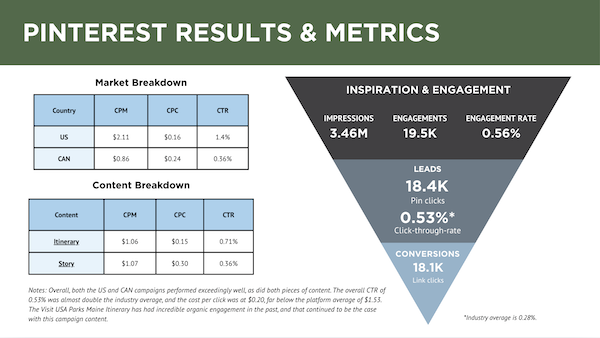
Thanks to a minimal comment culture, the fact that the platform provides an inspirational entry point and is frequented by planners who save content and respond to CTAs, Pinterest provided an excellent top-of-funnel tool as well as a strong driver of quality traffic to our branded Visit USA Parks site and the clients’ sites. Pinterest has proven to be a key source of qualified, quality traffic for Herrmann Global and partner websites, consistently demonstrating longer time on site than traffic from other social media sources.
Pinterest works particularly well due to Herrmann Global’s role as a publisher. With fresh, authentic, in-language content on the Visit USA Parks and Untraveled websites, Pinterest content teased a story filled with inspiration. Rather than hoping for a response to cold pins about booking pages, Herrmann Global was able to entice saves and clicks by inviting users to explore with Visit USA Parks or Untraveled.
Prioritize Pinterest
After testing and analyzing several Meta-to-Pinterest pivots in client campaigns, Herrmann Global was able to confidently remain nimble on behalf of our clients through the tumultuous 2025 and into the uncertainty of 2026. In fact, the success of this option transformed it into a proactive strategy for Herrmann Global clients who wished to maintain communication with international audiences. This not only allows destinations to reach travelers who still intend to visit the U.S. in the short term, it also serves the proven strategy of staying in communication with travelers who have no intention or ability to visit until the distant future.
Visit Maine
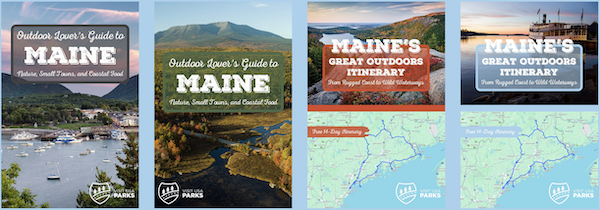
Maine returned to Herrmann Global for a Visit USA Parks campaign in 2026, and in fact this year’s strategy includes Pinterest from the start. Herrmann Global implemented a combination of Meta and Pinterest to promote their inspirational story, itinerary, and parks to prospects in the US, Canada, UK, and Germany, the campaign put all the best information possible in front of dreamers, planners, and wait-and-see travelers. With ~11 weeks remaining, the campaign has generated 1.24 million impressions and over 5,600 clicks.
Visit Park City, Utah
Park City, Utah experienced similarly objectionable responses to content on their owned brands, managed by Herrmann Global, starting in early 2025. The initial mitigation route was to pause all promotion on Meta to the target markets of Mexico, Brazil, the UK, and Australia, leaving the brand with only the existing high-intent tactic of Google search ads. Herrmann Global then suggested testing a combination of YouTube and Pinterest with the unused Meta budget. Based on initial findings of responsiveness without negative side effects, Herrmann Global and Park City launched into the new fiscal year with a new, nimble strategy across Meta, Pinterest, YouTube, and Google Search.

The result from Pinterest, between August 2025 and March 2026, was 3.43 million impressions, 12,260 clicks, a click-through rate of 0.33 percent, and a remarkable cost per click of $0.08. This, paired with improved brand standing in these markets as negative conversations no longer clouded promotional efforts.
Yellowstone National Park Lodges / Xanterra Travel Collection
The Yellowstone National Park Lodges / Xanterra Travel Collection campaign demonstrates Pinterest’s strength as a high-performing discovery platform for travel audiences. With Pinterest ad spend integrated from launch, the campaign significantly exceeded projections—delivering 2.47 million impressions against a 200,000 goal and generating 8,000 clicks, more than triple the estimated delivery. Performance metrics reinforced platform efficiency, achieving a 0.33% click through rate (above the 0.28% industry average) alongside an exceptionally low $0.11 cost per click and $0.38 CPM, highlighting Pinterest’s ability to drive cost-effective, high-intent engagement across global markets.

Summary & Takeaways
Pinterest has long been a highly valuable platform for destination marketing. It’s designed for inspiration, facilitates long-term visibility through the messy middle of decision making, and results in quality website traffic. And it has proven to be a space that is supportive, safe, and productive in the face of increasing toxicity and algorithmic drain. Herrmann Global, through campaigns on Visit USA Parks, Untraveled, and client brands, has seen an average click rate 35% higher than the industry average and a significant improvement in time on site as a product of those clicks. What started as a tactical pivot in the short-term has become a strategic priority.
Preparation, proactive strategy & capacity to pivot
The UK has begun to show some disinterest and decrease in performance on Pinterest, following European trends on other platforms and offline. However comments remain a psychologically safe space for users and advertisers on Pinterest, so Herrmann Global continues to include the UK in Pinterest strategies—with close monitoring. We continue to find campaigns to mixed markets—rather than singularly targeted campaigns—perform well for destination partners. This approach will prove particularly resilient as market, economic, and geopolitical indicators predict an increase in domestic travel by Americans in 2026 and 2027.
As European, Canadian, and Latin American travelers continue to daydream and, in some instances plan American holidays, and as US travelers continue to plan and dream, Pinterest promotions to combined target markets focused on extended and regional travel, mountain destinations, and bucket list daydreaming ideas will remain a priority.
Just as Pinterest campaigns that include a mix of audiences perform well and facilitate flexibility, mixed platform campaigns—such as Meta, YouTube, and Pinterest in combination—increasingly allow Herrmann Global to reach travelers where they are emotionally and online (often in multiple stages and locations). Whether unaware, planning, dreaming, or even hating on Facebook, Pinterest, or YouTube, users can be reached with an appropriate tone, in the most fitting format, and the right tool. Furthermore, having a platform mix built into a campaign also facilitates agility if and when underperformance and negativity begin to surface in one realm.
Ultimately, this is the success of Pinterest for destinations across the U.S. during a time of uncertainty, tumultuous policy and sentiment, and digital promotion and conversations: agility. The ability to shift from Facebook to Pinterest for markets that need a gentler touch and a more peaceful scrolling environment, to have the confidence and composure to remain nimble and shift proactively mid-campaign, and to reassure hardworking DMOs their brands are represented and received warmly is the intersection of a stable and productive social platform with the care and skill of the Herrmann Global team.